Paula Freeman
Crimson LakePaula Freeman, the mother of Lauren Freeman and Dynah Freeman, is encountered through the accounts and theories that gather around her daughter’s murder. In conversation with Ted Conkaffey, she describes a home repeatedly visited by strangers and a community crowded with incompatible memories. Her tentative interest in a kinder explanation does not establish what happened; it shows the emotional pressure exerted by not knowing.
Identity and Family
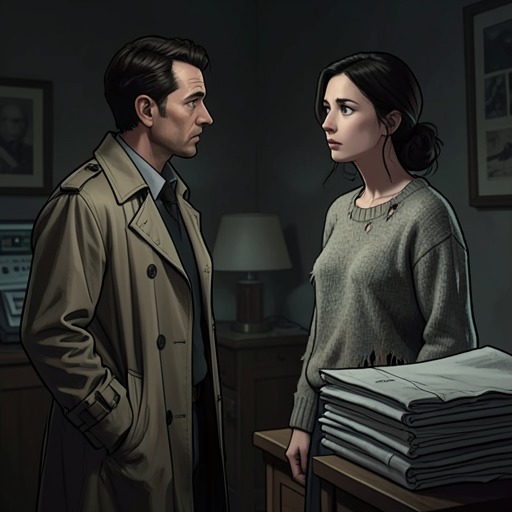
Paula is a short, blonde woman whom Ted meets at the entrance to her living room. She mistakes him for Dynah, who is expected home, before he introduces himself as Ted Collins. When she learns he is police, she apologizes and explains that she has become wary of people arriving at the house. Her connection to Lauren is at the center of the encounter, while her expectation of Dynah places the murdered woman within a surviving family still living with her absence.
A Home Open to Intrusion
Paula says that journalists and other strangers come to the house, sometimes claiming to have seen something or to know something about the case, and sometimes insisting that Amanda is innocent. The visitors turn the family home into a point of public contact with a crime that has not stopped attracting attention. Paula’s caution is practical: she has learned that a knock at the door may bring someone seeking information, or someone eager to offer a theory.
The volume of these claims has made certainty harder, not easier. Paula says that people repeatedly tell her they were present on the night Lauren was killed. She rejects the idea that all of them can be telling the truth: if every claimant’s account were accepted, the gathering on the mountain would have been a large rave rather than the small group of young people she understood it to be. She estimates that about a hundred people from Lauren’s school year claim to have been there. Their numbers and differing versions leave Paula with no single account she can safely hold as definitive.
The Consoling Alternative
Paula recounts one caller’s theory: a man in the bush had been with Lauren and Amanda, attempted to rob them, and killed Lauren while Lauren was protecting Amanda. The caller connected this idea to robberies involving a man targeting young girls in cars. Paula presents this as one of the stories offered to her, not as an established account of the crime.
Even so, she recognizes why it appeals. In this version Lauren still dies, but she becomes a protector, and her death acquires a meaning that Paula finds easier to bear. Paula admits that a small measure of relief would be welcome and that she would like to believe some of the stories people bring her. Her response is not confirmation of the theory; it makes visible the pull between evidentiary uncertainty and the human desire for an explanation that gives loss a shape.
Narrative Role and Limits
Paula’s conversation with Ted gives the case a family perspective distinct from the public appetite for mystery. The many supposed witnesses and their competing accounts threaten to turn Lauren’s death into a collection of stories, while Paula must live with the difference between a possibility and something she can know. Her openness to a more generous version is therefore inseparable from her skepticism about the crowd of people claiming to remember the night.
Paula does not solve the murder or supply firsthand testimony about its decisive events. Instead, she shows what unresolved violence leaves behind in the people closest to the victim: repeated approaches from outsiders, proliferating explanations, and the temptation to accept a story because it offers even slight relief. Her account keeps that temptation in view without mistaking consolation for proof.